Playbook: Winning foodservice leisure accounts


Leisure operators are under pressure to give guests more reasons to visit, stay longer, and spend once they arrive. For many venues, food and beverage is the answer.
2026 menu refreshes showcase how leisure foodservice is moving beyond standard concession fare: pizza doughnuts added at Coors Field, banh mi hot dogs and boozy coffees at Daikin Park, berbere-seasoned fries at the San Diego Zoo, tuna poke bowls at Puttshack, and hot honey sausage pizza at AMC Theatres… to name just a few.
For food and beverage manufacturers, that creates opportunity. Winning the business, however, isn’t always straight forward. Leisure sales often deal with product-format-fit, distribution, right-contact, and follow-up problems.
First Bite’s dataset of 131,700+ U.S-based leisure operators makes it possible to map the market’s $60B potential, access verified decision maker contact information, and automate timely outreach.
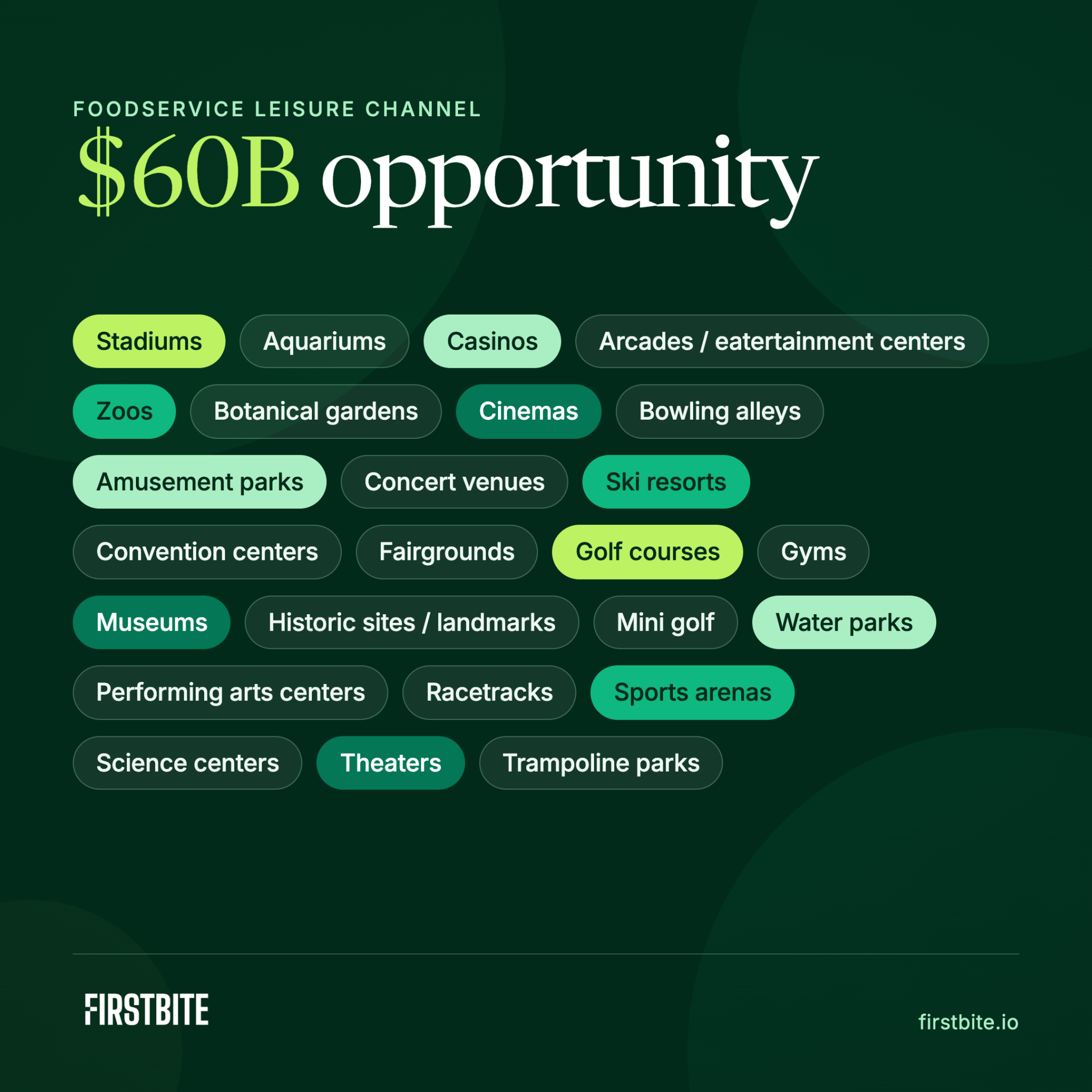
Below we break down what food and beverage manufacturers should consider when targeting stadiums, attractions, theaters, zoos, amusement parks, and other leisure operators.
Tips to close more foodservice leisure deals
1. Start with distribution
An operator may love your product, but they need an easy path to buy it.
Many leisure venues work through approved distributors or established procurement systems. At Lucas Oil Stadium, for example, Sodexo Live! is the sole licensed food and beverage operator. Identifying who manages foodservice decisions is an essential piece of the puzzle that can be difficult to find.
This is information that First Bite’s leisure dataset tracks. Before investing time in any sales efforts, you can determine which distributor or management company a venue works through and cater your outreach accordingly.
Be sure to include distributor names, item numbers, and relevant ordering information whenever possible. Don't make the buyer figure out how to source your product. Put distributor availability and SKUs directly in your outreach.
2. Map the buying structure before you sell
Depending on the venue, foodservice may be managed internally, by a third-party hospitality company, or through a combination of corporate procurement and local culinary teams. The person developing the menu may not be the person who approves the supplier.
That makes role mapping especially important.
Instead of relying on one contact, look for the people responsible for culinary, food and beverage, procurement, concessions, operations, and executive oversight. Determine whether a management company or other partner also sits between your brand and the venue.
This information is also included in First Bite’s leisure dataset. We provide ranked and verified decision maker contacts that match how the operator is structured.
3. Sell the format, not just the flavor
A great product in the wrong format is still the wrong product.
Leisure venues often have unusual operating constraints: extreme rush periods, small kiosks, limited preparation space, mobile concessions, vending and grab-and-go environments, catering operations, and high-volume event service.
Think about the actual use case before deciding which SKU to pitch.
A single-serve or RTD product might make sense for a poolside kiosk. A portable handheld could work at a stadium concession stand. Bulk formats may make more sense for banquet and event operations. Then build outreach around that application.
Instead of: “We’d love to introduce you to our chicken products.”
Try: “For concession stands, we’d recommend the fully cooked, individually portioned SKU. It reduces on-site prep and gives teams a format designed for short, high-volume service windows.”
The more immediately a buyer can picture the product inside their operation, the easier it is to evaluate.
4. Make speed and throughput part of the pitch
At leisure venues, operational efficiency is part of the product specification.
Guests have a limited window to buy food without missing the game, movie, attraction, or event. Long lines can therefore translate directly into lost sales.
Nearly four in five fans surveyed by checkout provider Mashgin said they spend more on concessions when lines are shorter.
That changes how manufacturers should position products in sales outreach.
Preparation time, portion consistency, labor requirements, packaging, portability, and speed of service may be as important as flavor.
If your product eliminates a prep step, reduces assembly time, requires less equipment, travels well, or works in grab-and-go service, say so. "Ready in 30 seconds" is often more useful than "premium quality."
5. Give operators something new to promote
Leisure venues have another challenge: giving people a reason to come back.
Unlike a new attraction, food and beverage programming can change quickly. That makes seasonal items and limited-time offers useful tools for creating something new without a major capital investment.
Punch Bowl Social, for example, has paired food and beverage LTOs with holiday programming and reported that month-long promotions helped generate traffic and revenue by giving guests time to return. Hersheypark has similarly used limited-time food and beverage alongside entertainment and events to encourage repeat summer visits.
Don't only pitch your SKU as a permanent menu addition. Run sales campaigns focused on offering LTO ideas that are seasonal, regional, or culturally specific.
6. Look for segment-specific sourcing opportunities
Some leisure segments have priorities that can make certain products particularly relevant.
Zoos and aquariums are a good example.
In 2025, 71% of the AZA-accredited facilities reporting on green practices said they sourced local food for visitors. This makes local sourcing a documented sustainability priority across much of the segment.
For manufacturers with local production, sustainable sourcing, compostable packaging, or other relevant credentials, those attributes deserve prominent placement in zoo and aquarium outreach.
The same principle applies elsewhere: understand what matters to the segment before deciding what part of your product story to lead with.
7. Make allergen and dietary information easy to evaluate
Public-facing venues serve enormous and diverse audiences, which makes dietary and allergen information operationally important.
Major venues increasingly make this information readily available to guests. Tampa Bay's ballpark publishes an allergen grid, Michigan Stadium provides an allergen guide, and Hersheypark lets guests search dining locations by dietary needs and view common allergens and ingredients.
Manufacturers should make the same information easy for buyers to evaluate.
Include major allergens, ingredient information, relevant dietary attributes, preparation requirements, and cross-contact information in your sales materials. If a product is gluten-free, vegan, nut-free, or suited to another dietary need, make that known in your pitch.
8. Reduce the risk of trial
Getting a leisure buyer interested is only the first step. The next question is: how easy is it for them to try the product?
Samples, introductory pricing, distributor-supported promotions, and rebates can all reduce that barrier. The simpler the process, the better.
Avoid making operators complete a long form, track down obscure purchase information, or wait weeks to understand whether they qualify. If you're running a rebate, clearly explain eligibility, distributor requirements, redemption steps, and deadlines.
First Bite’s digital rebate program and sampling workflows can eliminate 75% of administrative burdens and drastically reduce redemption timelines.
9. Build human follow-up into the sales motion
Leisure isn't a segment where a cold email sequence should do all the work.
Complex buying structures, distributor requirements, menu development, samples, and operational questions create natural reasons for human follow-up.
Use email to identify interest. Then build in calls, sample follow-ups, distributor coordination, broker involvement where applicable, and in-person conversations.
The foodservice leisure opportunity
Leisure operators are using menus to create novelty, increase convenience, support seasonal programming, and capture more spending from every visit. In 2026 alone, venues ranging from ballparks and movie theaters to theme parks and mini-golf venues have continued investing in new food and beverage experiences.
For manufacturers ready to pursue the opportunity, targeted prospecting pays off.
First Bite’s foodservice leisure dataset covers 131,700+ operators across the U.S., making it possible to filter for right-fit accounts, reach the right decision-makers, and run targeted outreach at scale around why your product belongs there.
Read more

Why you need a CRM that’s purpose-built for foodservice

Foodservice and leisure sector operator data now available in First Bite

How to get more replies from foodservice operators: 1M+ emails analyzed
Start closing better foodservice deals today
