The email sequence strategies that win foodservice deals


At First Bite, we've worked with 100+ food manufacturers to build outreach campaigns that convert right-fit operators. Across countless engagements with sales leaders, brokers, operators, and manufacturers, we've seen that email sequences are one of the highest-leverage tools available to foodservice sales teams.
The eleven email sequence strategies below are based on the prospecting and account-growth motions we see First Bite users having the most success with. Each includes a practical use case, recommendations for building a target list, a suggested cadence, and insights from our Activate team.
These frameworks are built around real sales motions that food manufacturers use to open new doors, increase account penetration, and reactivate dormant opportunities.
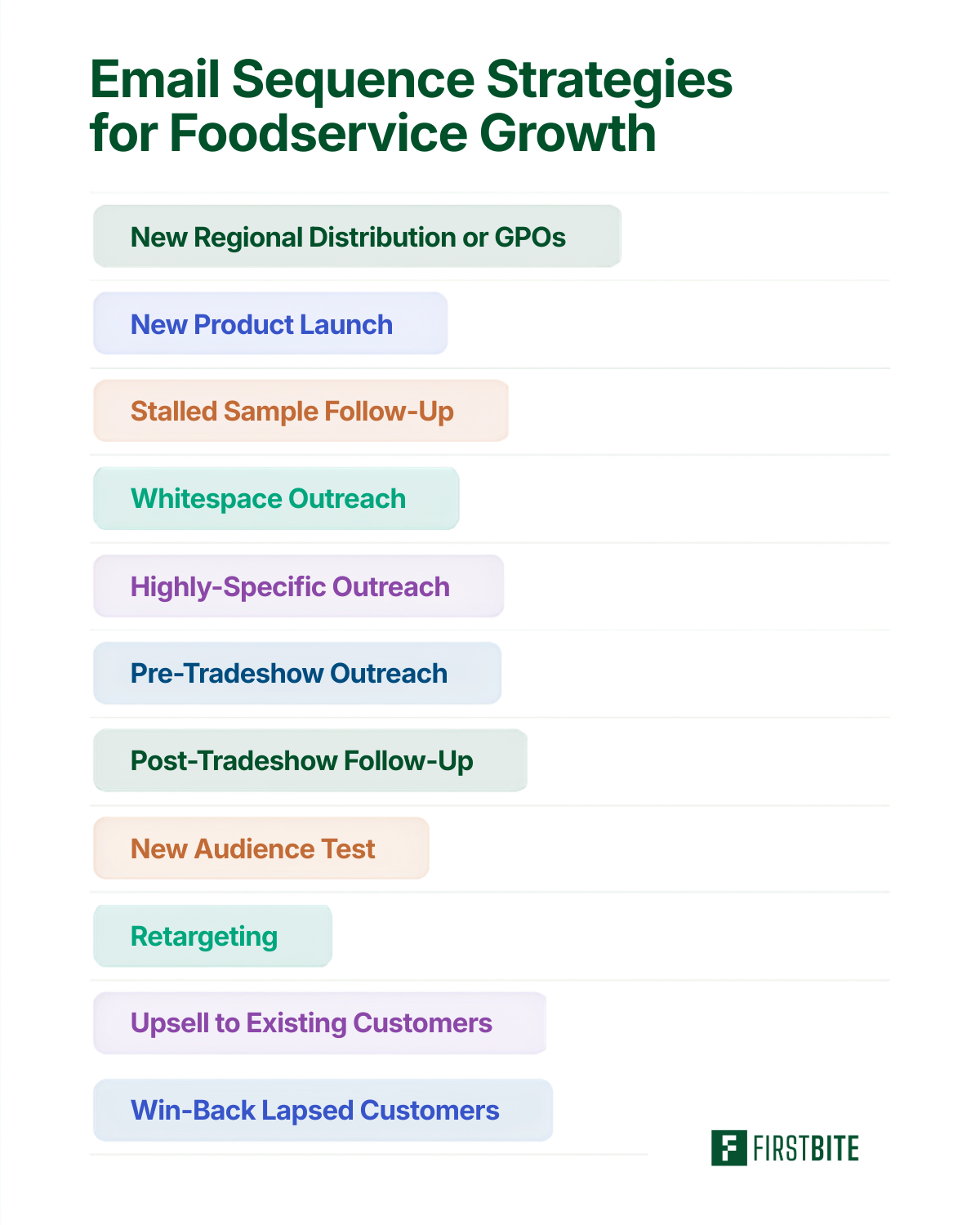
11 Proven Email Sequence Strategies for Foodservice Sales
1. New Regional Distribution or GPOs Sequence

The strategy: When you land a new distributor partnership or GPO agreement, you suddenly have a new coverage window. Use First Bite geographic filters to target the operators in your new region who fit your ideal customer profile, letting them know your product is now available locally.
Why it works: It can be a pain for operators to jump through hoops to get products outside of their preferred distributors. By sharing the news of new distribution partnerships, you increase the likelihood of finding operators who are willing and able to buy through your newly available channel.
How to build the list: Use state, DMA, or zip code filtering and menu-search to identify operators in the new coverage area who are already buying in your category. You're looking for operators who already need what you make — they just didn't have an easy way to get it.
And if working with a national distributor, watch to see if a product starts getting pulled through a particular hub, then launch a campaign to operators within the radius of that location in order to increase regional volumes.
Sequence structure: 4-5 emails over 3 weeks. Lead with the distribution news, follow with a proof point (customer story, product benefit), close with a sample, rebate, or meeting CTA.
“We recently helped a client target K-12 districts in the west coast after they set up new SKUs with a distributor that caters to that channel. Using First Bite’s target table, we pulled all of the districts in that region and launched email sequences that shared availability, getting ahead of the operator’s inevitable question about ease of ordering. Distribution can be somewhat of a chicken and the egg thing. But once you've got the egg, you can let everyone know that the omelet can be made now!”
— Ariana Thrasher, Sr. Account Manager, First Bite
8+ years foodservice experience
2. New Product Launch Sequence

The strategy: A new product launch sequence that scales outreach to multiple operator segments simultaneously — each receiving messaging tailored to how the product fits their menu.
Why it works: A new product launch is exciting and something to capitalize on. Email sequencing lets you run parallel tracks to different segments (QSR vs. fine dining vs. healthcare, for example) so you can ensure the best message reaches each audience.
How to build the list: Segment your target list by operator type, cuisine, or menu data. A new plant-based protein, for example, might go to operators with existing vegetarian menu items and a separate track to operators with no vegetarian options at all.
Sequence structure: 4–5 emails over 3 weeks. Announce, educate, social proof, close. Consider including a first-order free rebate.
"This strategy is highly effective for well-established manufacturers, especially those that are branded on menu, because they can use First Bite’s menu search filtering to identify operators who already buy from them and let them know that there's a new product available. You can get really laser focused on who you reach out to."
— Ariana Thrasher, Sr. Account Manager, First Bite
8+ years foodservice experience
3. Stalled Sample Follow-Up Sequence

The strategy: A re-engagement sequence targeting operators who received a sample but went dark.
Why it works: Sampling efforts can go to waste when there's no follow-up cadence. A structured email sequence can surface deals that are still warm but just slipped through the cracks.
How to build the list: Pull operators who requested or received samples more than 30 days ago with no activity since. Segment by how far into the conversation they got.
Sequence structure: 5 emails + 3 phone calls spread over 20 days. Keep your outreach short. Don’t re-pitch. Just ask: “Have you had a chance to try the sample?” Then invite feedback, include supportive menu applications, recipes or prep tips, and make it easy to take the next step.
"Even when outreach campaigns result in high levels of sample requests, the work to close a deal isn’t done. When First Bite users intentionally run follow-up email sequences to operators who have stalled after product trials, we see significantly higher success rates. Operators get busy. You need to have repeatable workflows in place to help convert them."
— Meg Nichols, Account Manager, First Bite
6+ years foodservice experience
4. Whitespace Outreach Sequence

The strategy: A sequence targeting operators where your product category isn't currently represented on their menu — aka: your biggest opportunity.
Why it works: Menu intelligence tells you as much about what's missing as what's present. Instead of calling on every operator, you can prioritize those with the greatest opportunity to add your category or upgrade from a competitor. That makes your outreach timely, relevant, and rooted in observable data.
How to build the list: Use First Bite's menu data to identify operators in your target segment that don't currently feature your product category. You can also create a second audience of operators serving a competing product if your goal is displacement. Layer in filters like region, operator type, distributor, or menu style to make your outreach even more relevant.
Sequence structure: 3-5 emails over 3 weeks. Lead with the insight ("We noticed your menu doesn't currently include X"), connect it to a trend or customer demand signal, and offer to fill the gap and provide a product sample.
“One of our clients used menu data filtering to identify more than 24,000 pizzerias where their product wasn’t yet sold. They then broke those operators down into addressable segments and launched email sequences to grow their market share.”
— Ariana Thrasher, Sr. Account Manager, First Bite
8+ years foodservice experience
5. Highly-specific Outreach Sequence

The strategy: A targeted email sequence built for a narrowly defined group of operators who share meaningful characteristics.
Why it works: The more relevant your audience, the more relevant your message. By narrowing your list, you can write outreach that feels personal while still executing it at scale.
How to build the list: Use First Bite's filters to create a highly qualified audience. For example, identify operators who feature at least two or three menu items related to your category. The resulting list may be smaller, but it's far more likely to contain operators with genuine product fit.
Sequence structure: 3-5 emails over 3 weeks. Reference the specific attributes that qualified them for the campaign so your outreach reads like a one-to-one email instead of a mass send. For example: "I noticed you're already serving dishes featuring [ingredient] and [ingredient], I thought [product] might be a natural fit for your menu."
“Smaller, highly targeted campaigns consistently outperform broad outreach because recipients can immediately see why you're contacting them. I’ve had clients achieve sample interest from as much as 30% of their list when they take this approach.”
— Ariana Thrasher, Sr. Account Manager, First Bite
8+ years foodservice experience
6. Pre-Tradeshow Outreach Sequence

The strategy: A sequence sent to registered attendees before a tradeshow, with the goal of booking booth meetings in advance or driving traffic to the booth.
Why it works: The operators who agree to a meeting before the show are genuinely more interested in your solutions than cold floor traffic. Pre-scheduling also means your sales team walks in with a full calendar instead of hoping for foot traffic.
How to build the list: Cross-reference your target operator list against show attendee lists. If participating in a regional event, use zip code filtering to reach operators within a certain radius of the venue.
Sequence structure: 2 emails in the 2–3 weeks before the show. Lead with what you're showing, offer an incentive (try a new product, etc.), share your booth number, and try to schedule a specific time.
“When attendees have your brand top of mind and know why they should stop by your booth, they're much more likely to seek you out instead of just walking past."
— Megan Ryan, Account Manager, First Bite
12+ years foodservice experience
7. Post-Tradeshow Follow-Up Sequence

The strategy: A sequence sent to everyone you met at a show, segmented by conversation quality and next step.
Why it works: Most tradeshow leads go nowhere because follow-up is inconsistent. A sequenced approach ensures every contact gets a touchpoint, and the hottest leads get priority attention.
How to build the list: Use notes from booth conversations and badge scans to segment contacts into tiers: hot (ready to buy), warm (interested, not urgent), and cold (curious but early stage). Each tier gets a different sequence.
Sequence structure: 2-3 emails over 2 weeks, breaking up lead lists into "interested in samples" and "stopped by the booth" so messaging can be tailored to real conversations. Further break down lists by specific product, if possible. Personalization here dramatically improves reply rates, and email sequencing tools make this possible to do at scale.
“The biggest mistake we see food manufacturers make is to let these warm leads never get followed up on, or bucket everyone into one list. You can spin up post-show follow up sequences in 10 minutes, or use a saved template, and let this run in the background while you are packing your bags for the next event.”
— Meg Nichols, Account Manager, First Bite
6+ years foodservice experience
8. New Audience Test Sequence

The strategy: A lightweight sequence you run before committing marketing budget to a new segment.
Why it works: Expanding into a new operator type (say, a beverage brand moving from QSR into healthcare) is a big investment. A small, structured email campaign can surface real signal about demand before you fund a full go-to-market push.
How to build the list: Build a test list of 100–200 operators in the target segment. Keep it small and tight — the point is to get real data fast, not exhaust the full segment.
Sequence structure: 3 emails over 2 weeks. Touch on a core value proposition tailored to the new segment's specific pain point (e.g., for healthcare operators, compliance or consistency at scale rather than speed/throughput messaging that works for QSR). Build credibility for operators unfamiliar with your brand. Track reply rates as your primary KPI, looking for results above ~8-10% to signal real demand and justify moving to a broader campaign.
"Before you spend six figures on marketing programs, find out if your target segment actually wants your product. I have seen too many brands commit to a segment that looks good on paper before testing whether they actually convert. Run rapid outreach tests and see who replies. Within a few weeks, you'll know if there is real demand and whether you should invest."
— Reed McCord, Founder and CEO, First Bite
13+ years foodservice experience
9. Retargeting Sequence

The strategy: A sequence targeting operators who have previously engaged with your brand — visited your website, clicked a link in a prior email, downloaded a spec sheet, etc. — but haven't converted.
Why it works: These are warm contacts who already know who you are but had an interrupted journey. A retargeting sequence picks up the thread.
How to build the list: Work with your marketing or sales team to pull contacts who have shown engagement signals in the last 60–90 days but haven't taken a conversion action (sample request, meeting booking, or purchase).
Sequence structure: 4 emails over 3 weeks. Acknowledge their interest implicitly ("You've been exploring [product category]..."), offer new information or a reason to act, and make the next step obvious and easy.
“When you have access to data like this, it’s worth acting on. Try offering a custom rebate. Someone who clicked a link three months ago showed interest and may just need a nudge to take the next step.”
— Megan Ryan, Account Manager, First Bite
12+ years foodservice experience
10. Upsell to Existing Customers Sequence

The strategy: A sequence to current customers introducing a new SKU or product line they aren't yet buying.
Why it works: Existing customers are your highest-converting audience. They trust you, they know your quality, and they have an established way to buy. All they need is awareness and an easy path to trial.
How to build the list: Use First Bite to do a menu search for your brand to see who is carrying a specific product. Any customer who is buying Product A but not Product B (and where Product B is relevant to their menu) is a candidate.
Sequence structure: 3 emails over 2 weeks. Lead with context – "I see you are carrying Product A and with summer coming up, we think you'd love our Product B, can I send you a sample?" Connect the new product to their existing usage, and offer a trial opportunity. Mix in recipe inspiration from your marketing team to highlight use cases.
“Manufacturers often don’t have clear visibility into who exactly is buying their product through a distributor, so using menu search tools helps provide much needed insight for upselling.”
— Emilie Wood, Head of Customer Success, First Bite
7+ years foodservice experience
11. Win-Back Lapsed Customers Sequence

The strategy: A re-engagement sequence targeting accounts that used to order but have gone silent — no purchases in 90+ days.
Why it works: Lapsed customers are easier to re-win than cold prospects. They bought from you once, which means the product fit was there. Something changed — distribution, price, a rep transition, or just inertia. A well-crafted sequence can identify which accounts are recoverable.
How to build the list: Pull any account with a purchase history and no activity in the last 90–180 days. Segment by how recently they lapsed and how large they were as an account.
Sequence structure: 3 emails over 2 weeks. Acknowledge the gap without being awkward ("We haven't connected in a while and wanted to check in"), offer something new (a new product, a promotion, updated pricing), and make it easy to restart.
“Win-backs don't necessarily mean unhappy customers. It could be operators who ran a limited-time offer that need communication in order to encourage that next order. When using this strategy we see high rates of renewed interest.”
— Megan Ryan, Account Manager, First Bite
12+ years foodservice experience
Improve Email Sequencing
Start with a campaign that maps to something already on your calendar — an upcoming trade show, a distribution launch, a product you've been slow to move — and build from there.
Use these email sequence strategies not only to scale your sales outreach but to test and learn which approaches work best for your products and audience.
Reach out for a demo of First Bite email sequencing and prospecting capabilities.
Read more
Smart Flour achieves faster foodservice growth with First Bite

IFMA webinar recap: How manufacturers are fixing the broken foodservice prospecting model
Revolutionizing foodservice data with First Bite CEO Reed McCord
Start closing better foodservice deals today
