Template: Improve your next foodservice cold email sequence



Foodservice is different. The cold email playbook that works for SaaS or e-commerce doesn’t translate with culinary decision makers. Operators are time-crunched, distracted, and skeptical of anything that reads like marketing.
When done right, cold email sequences help you scale communication with right-fit buyers, chefs, and operators. Done wrong, it ends up in the trash with the rest of the mass-blast junk they get every day.
After handling thousands of foodservice cold email sequences, we've distilled what actually works — guidelines that have helped us achieve an average 8% reply rate, 4x the industry average. We're sharing them here because we want you to close more foodservice deals.
Keep in mind, though: cold email is an art, not a science, and every audience is different. You should always test what works for your specific product and customers. If you want hands-on help doing that, our Activate customers receive additional insights and 1:1 coaching to build target segments, iterate on sequences, analyze replies, and scale what works.
13 Tips for Better Cold Email Sequences
- Target just 100-400 contacts per campaign
- Use subject lines that signal relevance
- Offer immediate value
- Personalize
- Add social proof or credibility
- Use low-friction CTAs
- Plan on 5 touch points, sent every 3-4 days
- Keep messages short
- Make it casual and conversational
- Use text over design
- Don’t include links or attachments in your first email
- Don’t ignore deliverability
- Test, test, test
1. Keep your campaign lists tight (100–400 targets)
Bigger lists aren’t better. Sending to 100–400 highly targeted accounts at a time lets you stay specific, track what’s working, and personalize without burning out. We recommend building segments that focus on a specific region, chain size, menu item, cuisine type, or other relevant qualifier.
Keeping lists small also protects your sender reputation. Mass blasting to thousands of cold contacts is a fast track to the spam folder.
2. Write subject lines that create curiosity or relevance
Your subject line is the only thing standing between your email and the delete button. It should spark just enough curiosity to earn the open, without being clickbait. A subject like “Correct address for samples?” works because it feels personal and implies action without giving everything away upfront.
On capitalization: the cold outbound world is split on whether to title case subject lines. Our preference is lowercase, because it feels more human.
3. Offer immediate value
Many operators read email from their phones between rushes. The preview text — those first few words they see in the inbox — is just as important as your subject line. Don’t waste it on “Hope this finds you well.” Lead with something that immediately signals value or relevance to them. Make it about their world, not yours. The question to ask yourself: “Would I find this useful if I received it?”
4. Personalize
The fastest way to get ignored is to write an email that’s 80% about your brand and 20% about the recipient. Flip that. Reference their concept, their menu, their likely challenges. A chef at a fast-casual Mediterranean chain doesn’t care that your product won a FABI Award. They care whether it saves them prep time or fits a trending flavor profile.
Even light personalization — like mentioning their restaurant group, a recent opening, or a cuisine style — can signal that you actually looked them up. That alone sets you apart from 90% of the outreach they receive.
5. Add social proof that’s relevant to their segment
Name-dropping a Michelin-starred restaurant doesn’t mean much to an operator running 12 fast-casual locations. Match your social proof to your target. A stat, a short quote, or a quick case study from a similar operator goes a long way. “We’re on the menu at [comparable chain] and their ops team told us it cut prep time by 20%” is infinitely more compelling than “leading brands trust us.”
6. Use a single, low-friction CTA
Always, always, always end your emails with a question. This is more likely to generate a response. But only give them one thing to do, and make it easy to say yes.
“Would it make sense to send over a sample?” is better than “Can we schedule 30-minutes?” Operators are not going to block off their calendar for someone they’ve never heard of. Start small. A sample request, a yes/no question — these are low-friction ways to start a conversation.
7. Plan for 5 touch points, every 3–4 days
Most responses in cold email sequences happen after the 3rd or 4th follow-up. Set up a cadence of around 5 emails spaced 3–4 days apart.
You’ll generally see recommendations that say each follow up email should add additional value. We have not found that to be effective in foodservice outreach. Operators are busy and prefer to get straight to the point. A simple “Just wanted to bump this to the top of your inbox” or a one-liner re-stating your offer is perfectly fine. The goal is visibility.
8. Keep messages short
If your email is more than 140 words, it’s too long. Operators skim. You want them to get your point in under 30 seconds. Short emails also feel more like a real person reached out — which is the whole point.
9. Sound like a person, not a brand
Read your email out loud. Would you actually say this to someone at a trade show? If not, rewrite it. Avoid phrases like “I’d love to connect and explore synergies” or “we’re disrupting the foodservice space.” Write the way you’d talk to a buyer you just met. Casual, direct, respectful of their time.
10. Use plain text, not designed templates
A beautifully designed HTML email with your logo, brand colors, and product imagery is a great marketing push. It is not a great cold outreach email. Designed emails read as mass blasts. A plain text email reads as personal. When contacting cold leads, a text-only format consistently outperforms designed templates.
11. Don’t include links or attachments in your first email
Links in cold emails are a deliverability red flag. They can trigger spam filters before your email even reaches the inbox. Save the links and sell sheets for later in the sequence once you’ve established some engagement. Your first email should be pure text, this includes in your signature line.
12. Don’t ignore deliverability
You could write the perfect email and never have it seen if your domain has a bad sender reputation. Warm up new domains before you send at scale. Use a dedicated sending domain. Monitor bounce rates and spam complaints. Authenticate your emails with SPF, DKIM, and DMARC records. Deliverability isn’t glamorous, but it’s the foundation everything else sits on.
13. Test, test, test
Like we said before, cold email is an art, not a science. Constantly test different subject lines, calls to action, offers, value propositions, candances, and messaging to see what resonates. Just as importantly, test your audiences. A cold email sequence that falls flat with independent restaurants may perform exceptionally well with healthcare operators or regional chains. Change one variable at a time, measure the results, and let the data guide your next campaign.
Example Cold Email Sequence Template for Foodservice
Putting advice into action isn’t always easy. So, here’s an anonymized cold email sequence with success metrics.
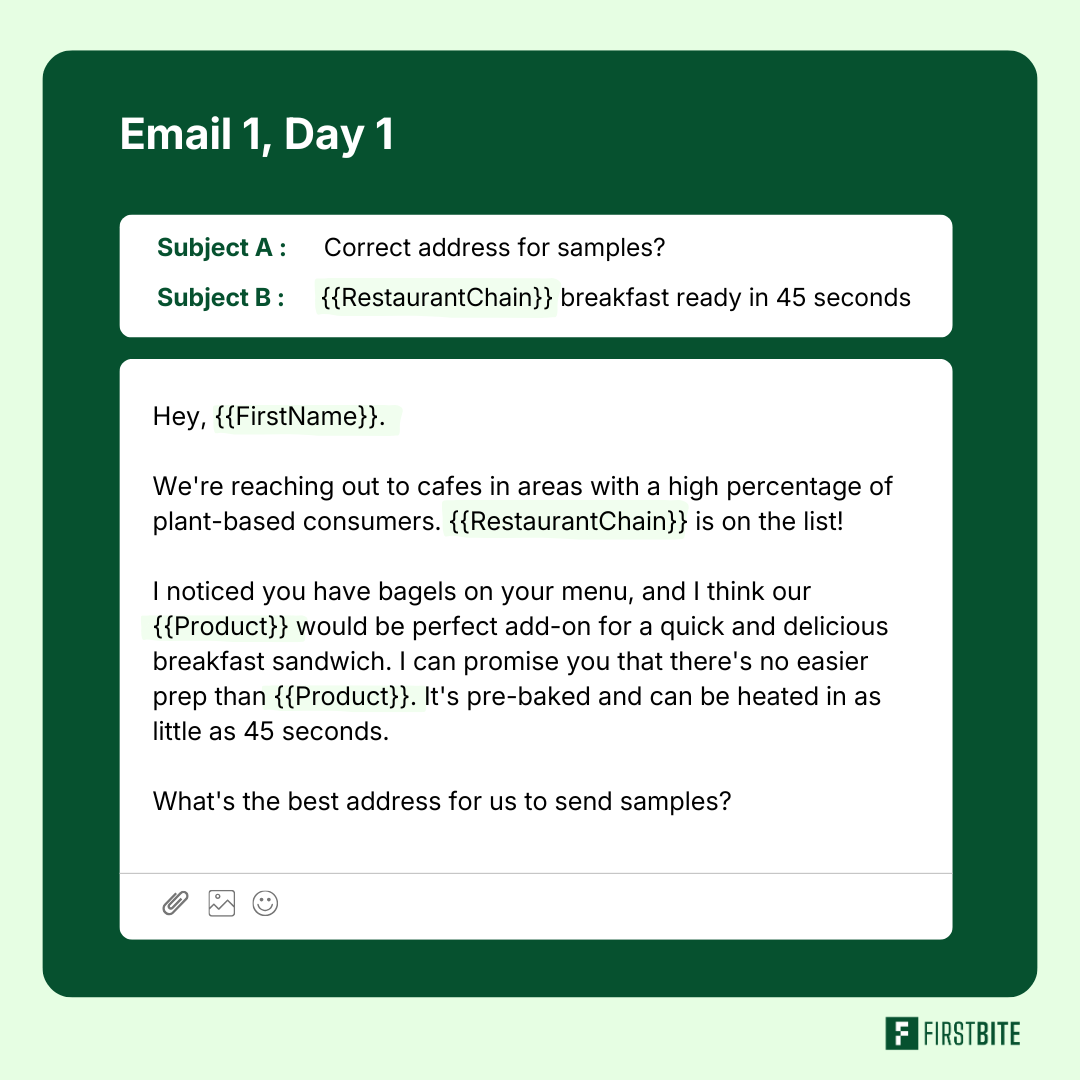
Email 1, Day 1
Key points
- Personalization – This email uses {{FirstName}} and {{RestaurantChain}}, making the recipient feel like the email was crafted specifically for them rather than being a generic mass email. It also acknowledges that the cafe is in an area with a high percentage of plant-based consumers, implying that the offer aligns with their customer base.
- Up Front – Foodservice operators are busy folks and they don’t like it when you beat around the bush. Get right to the point.
- Quick Value Proposition – It immediately highlights the ease of preparation (pre-baked and heated in as little as 45 seconds), which addresses a key pain point for foodservice operators: speed and convenience.
- Menu Relevance – By mentioning bagels on the menu, it connects the product to something the cafe already offers, making it easier for them to see the potential fit.
- Low Commitment CTA – Instead of pushing for a meeting, it simply asks for an address to send samples, making it easy for the recipient to say yes.
- Casual and Friendly Tone – The tone is warm, conversational, and non-pushy, making it feel like a genuine offer rather than a hard sell.
Result
- This email had a 22% reply rate.
Email 2, Day 3

Key points
- Concise & Direct – It respects the recipient’s time by getting straight to the point. Less is better in foodservice cold email sequences. You’ll notice that most of the emails in this campaign are actually just short follow up messages that don’t mention additional value props – that is by design.
- Clear CTA – The request to send samples makes it easy for the recipient to say yes.
- Continuation of the Conversation – It references the previous outreach without being pushy.
Result
- This email had a 9% reply rate.
Email 3, Day 7

Key points
- Creates Urgency – "I’m putting in sample orders tomorrow" gives a clear deadline, making it more likely the recipient will respond quickly.
- Simple & Low-Friction CTA – "Can I count you in?" is a yes/no question, reducing decision fatigue.
- Conversational & Friendly – The casual tone makes it feel less like a sales pitch and more like a personal invitation.
- Assumes Interest – Rather than asking if they want samples, it assumes they do, which can increase positive responses.
Result
- This email had a 4% reply rate.
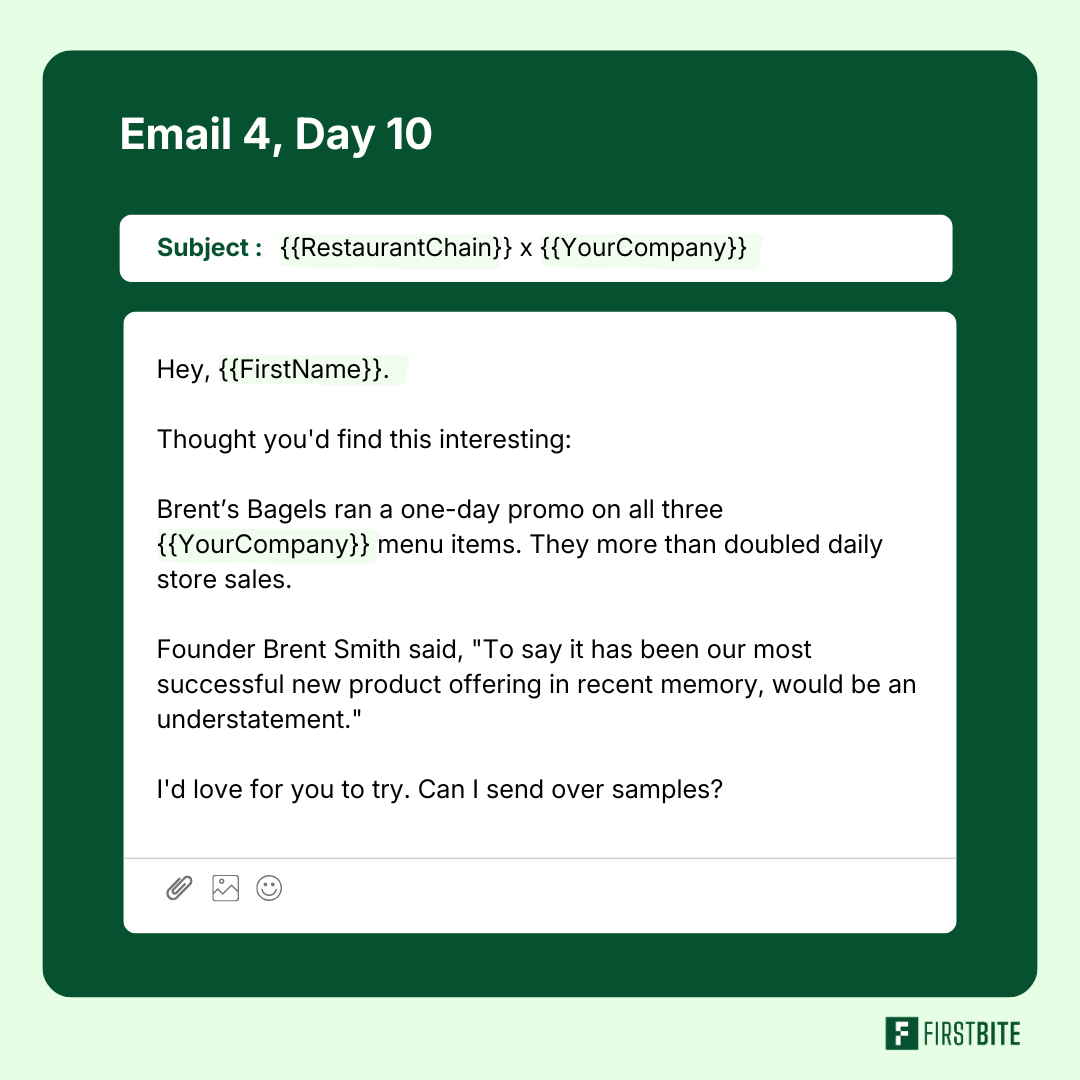
Email 4, Day 10
Key points
- Compelling Social Proof – Highlighting a real-world success story with measurable results makes the product more appealing.
- Clear & Engaging Hook – “Thought you’d find this interesting” piques curiosity and encourages the recipient to keep reading.
- Founder Testimonial – A direct quote from the founder of a similar restaurant adds credibility and emotional impact.
- Concise & Action-Oriented CTA – “Can I send over samples?” keeps the ask simple and easy to respond to.
Result
- This email had a 3.6% reply rate.
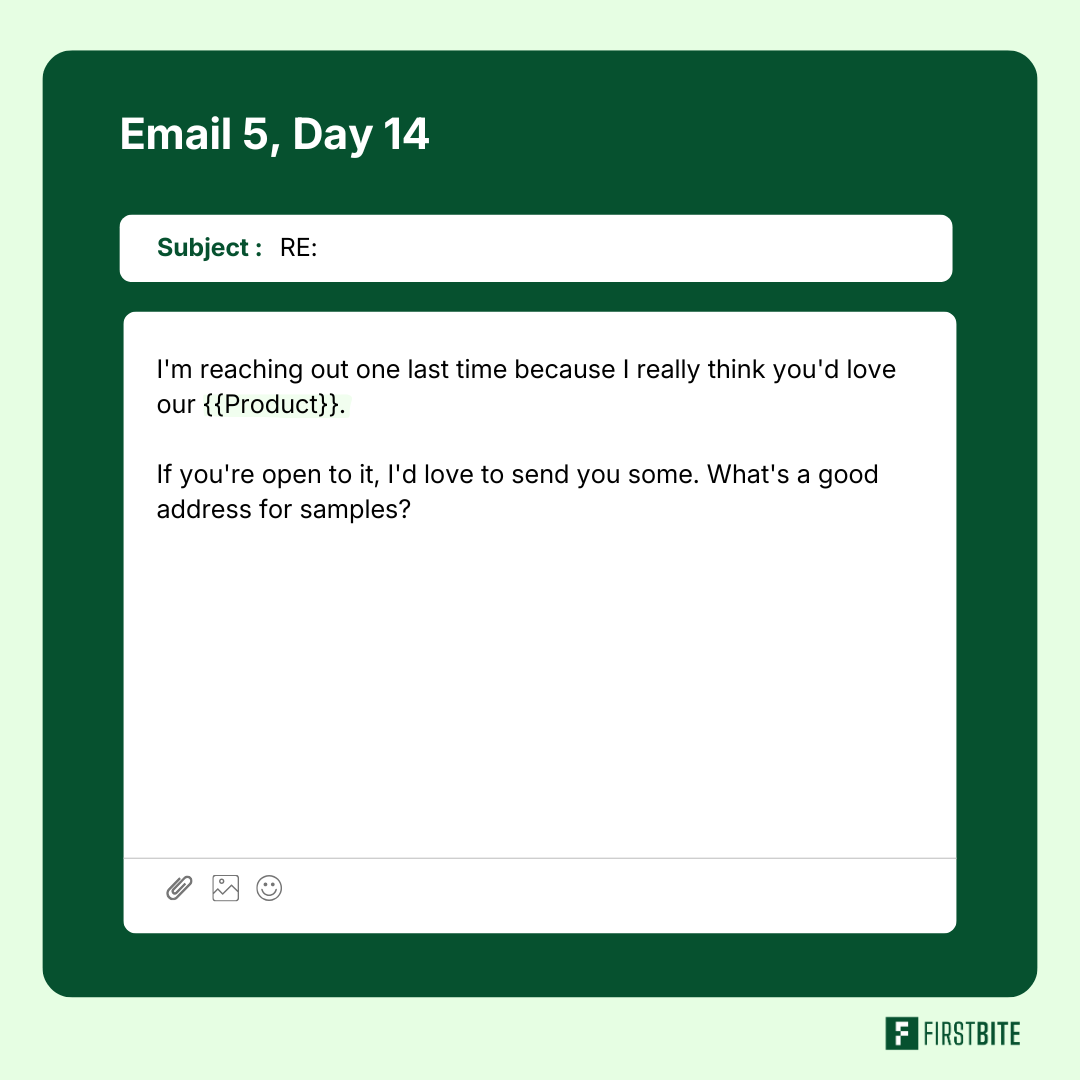
Email 5, Day 14
Key points
- Creates Urgency – "One last time" signals this is the final outreach, which can push indecisive prospects to respond.
- Keeps It Simple – The email is short and easy to read, making it more likely to get a reply.
- Low-Friction Ask – Offering free samples makes it easy for the recipient to say yes.
Result
- This email had a 3% reply rate.
Send Better Cold Email Sequences
Cold email in foodservice is less about volume and more about relevance. Operators have short attention spans and high tolerance for ignoring irrelevant outreach. The brands that break through are the ones that sound human, respect the operator’s time, and make it ridiculously easy to take the next step.
Start with a tight list of well-targeted accounts, write like a person, follow up consistently and briefly, provide value, and keep an eye on your deliverability.
---
See how your prospecting emails stack up against these tips by sending a cold email to operator@firstbite.ai, as if it was your target contact.
You'll receive a report that coaches you on how likely you are to get a response along with recommendations on ways to improve.
Read more

Smart foodservice prospecting, sweet results

Playbook: Winning foodservice leisure accounts

Making sense of the broker side of the business: A conversation with Julie Swift
Start closing better foodservice deals today
