How to find restaurant owner email addresses for outreach


Finding restaurant owner email addresses is a pain point every foodservice sales rep knows well. Unlike traditional B2B industries, restaurant decision-makers are fragmented across more than one million locations, ownership structures vary dramatically, and contact information changes constantly.
That's why foodservice sales teams often spend hours researching accounts before they ever send an email.
As Michelle Lane, VP of Foodservice Sales & Marketing at Mike's Hot Honey, explained during an IFMA webinar about fixing the black box of foodservice prospecting: "It's always been a very manual “Google searching or literally in person walking down the street” kind of process that you can't successfully scale."
With that in mind, here's a guide to sourcing restaurant owner emails, starting with the free options and working up to the tools built specifically to solve this problem.
Why finding restaurant owner email addresses is harder than it sounds
Three things make finding restaurant contact data uniquely difficult compared to most other B2B verticals.
First, the market size is massive with information that is highly fragmented and elusive. Historically, building an accurate target list and knowing your true addressable market meant cross-referencing half a dozen sources and filling in with guesswork. Lizzie King, SVP Sales & Growth at Tractor Beverage said on the same IFMA webinar: “It's a challenge just because there's so many."
Second, decision-maker contacts are hard to find. While we’re about to share numerous ways to uncover restaurant owner contacts, that doesn’t mean they're easy to source. Accurate corporate websites, staff directories, or LinkedIn profiles only exist for larger chains. Ownership and management structures also vary widely, from a single owner-operator running the kitchen to a regional group with a dedicated purchasing director, which makes it hard to apply one lookup method across the market. And independent restaurant owners frequently use a personal Gmail rather than a branded domain email.
Third, restaurant contact data decays fast. While general B2B contact data decays at roughly 22% a year on average, restaurant decision-maker data turns over even faster. Restaurant management positions (GMs, ops managers) run close to 40% annual turnover. Restaurants open, close, change hands, and turn over staff at a higher rate than almost any other industry. A contact list that was accurate six months ago can easily have a double-digit bounce rate today.
Option 1: Search Google, websites, and map listings to find restaurant owner emails
Google Maps, Apple Maps, Yelp, TripAdvisor, OpenTable, and Resy are all great for discovering restaurants and building a geography- or cuisine-based longlist, but can be lacking when trying to identify decision maker emails.
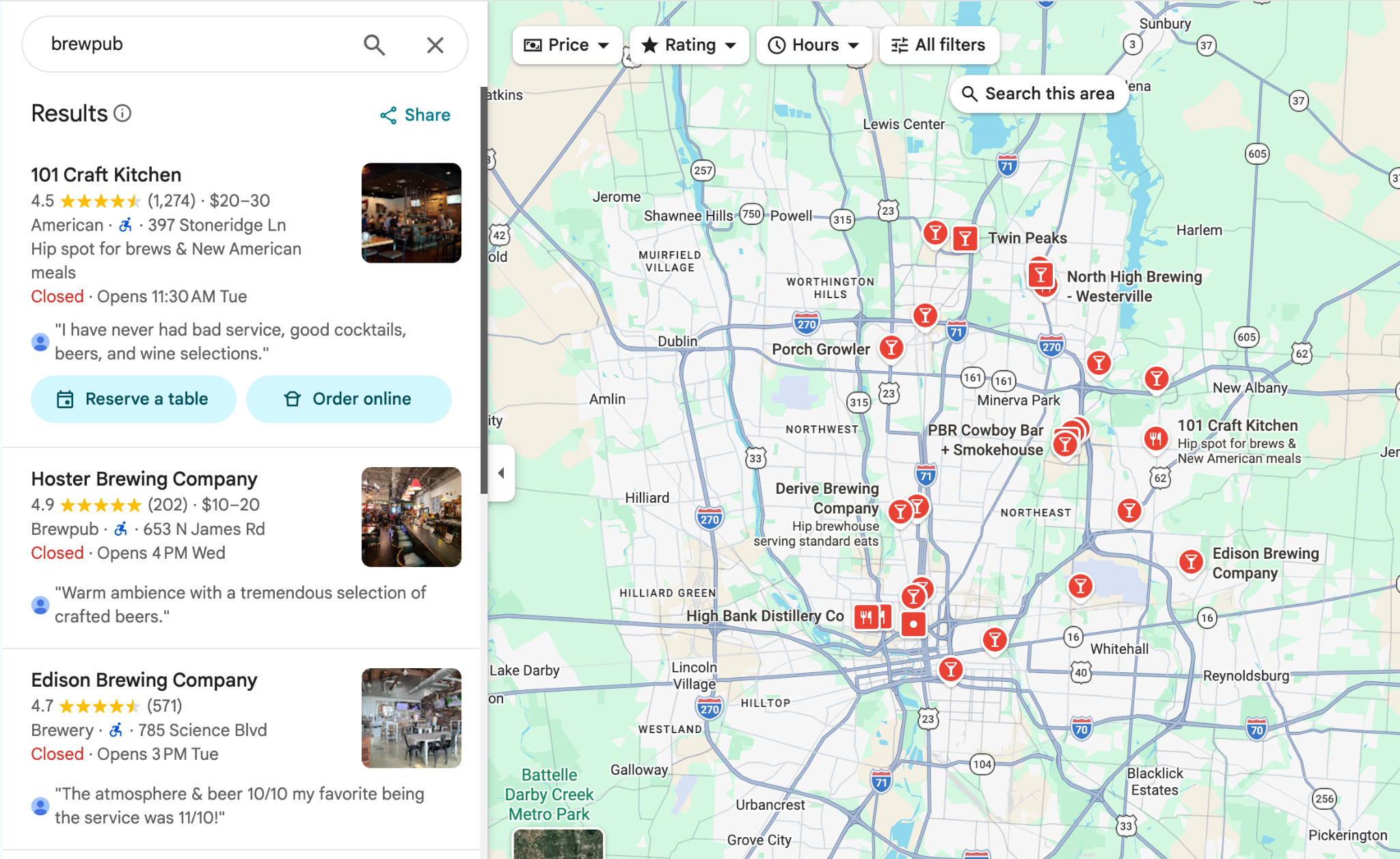
For example, if you’re a supplier of frozen potatoes, a Google Maps search for brewpubs in Columbus, Ohio will give you a starting list of potential restaurants to approach about your french fries. Of course, that won’t yield every restaurant with potatoes on its menu (there are diners with hashbrowns, food halls with tater tots, and many more to uncover), but it’s a start.
You can also see review counts, price range, and sometimes menu previews — all useful signals for qualifying fit before you ever reach out.
Once you have a shortlist, you need to jump over to the restaurant's website to confirm product-menu fit and uncover contact information. Independent restaurants sometimes list an owner or GM by name on an "About" or "Our Story" page. Multi-unit groups and franchises are more likely to have a corporate site with a leadership or "Contact Us for Vendors" page.
But there’s a massive time cost to this level of manual prospecting and no guarantee you’ll find all the info needed for a restaurant email list. As Ryan Ewald, Director of Foodservice at Branding Iron Holdings, says: "We don't have time to scroll the internet all day to figure out which operators we should be calling."
Pros:
- Free
- Map-based targeting
- Context (reviews, popularity, menu snapshots) for judging fit
Cons:
- Nearly impossible to find your total addressable market this way
- Time consuming, requiring clicks into each listing
- Most restaurant websites are built for guests, not vendors — there's rarely a named decision-maker with an email address, leaving you with general info@ emails
Option 2: Search LinkedIn and social media to find named restaurant decision-makers
For chains and multi-unit groups, LinkedIn is often the best free source for an actual name and title — "Director of Culinary Operations," "Restaurant Owner," and so on. You can filter by title, industry, company size, and location. With paid access to LinkedIn Sales Navigator, you can get more specific and filter by postal code or account-level signals like new hires and recent activity. Instagram and Facebook can also surface an owner's name, especially for independents where the owner runs the account personally.
But foodservice market coverage here is thin and you end up missing a large share of restaurant-owner TAM by default. Additionally, email addresses are rarely public and you are left messaging them directly on the social sites, or using secondary email enrichment tools (Hunter.io, Clay, etc.) to generate possible email addresses.
Pros:
- Free (or paid access to LinkedIn Sales Navigator)
- Name and title to work with instead of a generic inbox
- Limited filtering
Cons:
- LinkedIn coverage is thin for foodservice, especially independent restaurants
- Tracking outreach that happens via social media in your CRM requires secondary tools that aren’t supported by all platforms
- Email enrichment tools carry another cost and aren’t 100% accurate, meaning another expense and potentially high bounce rates or unreachable targets
Option 3: Ask an LLM to help build your restaurant list + find contacts
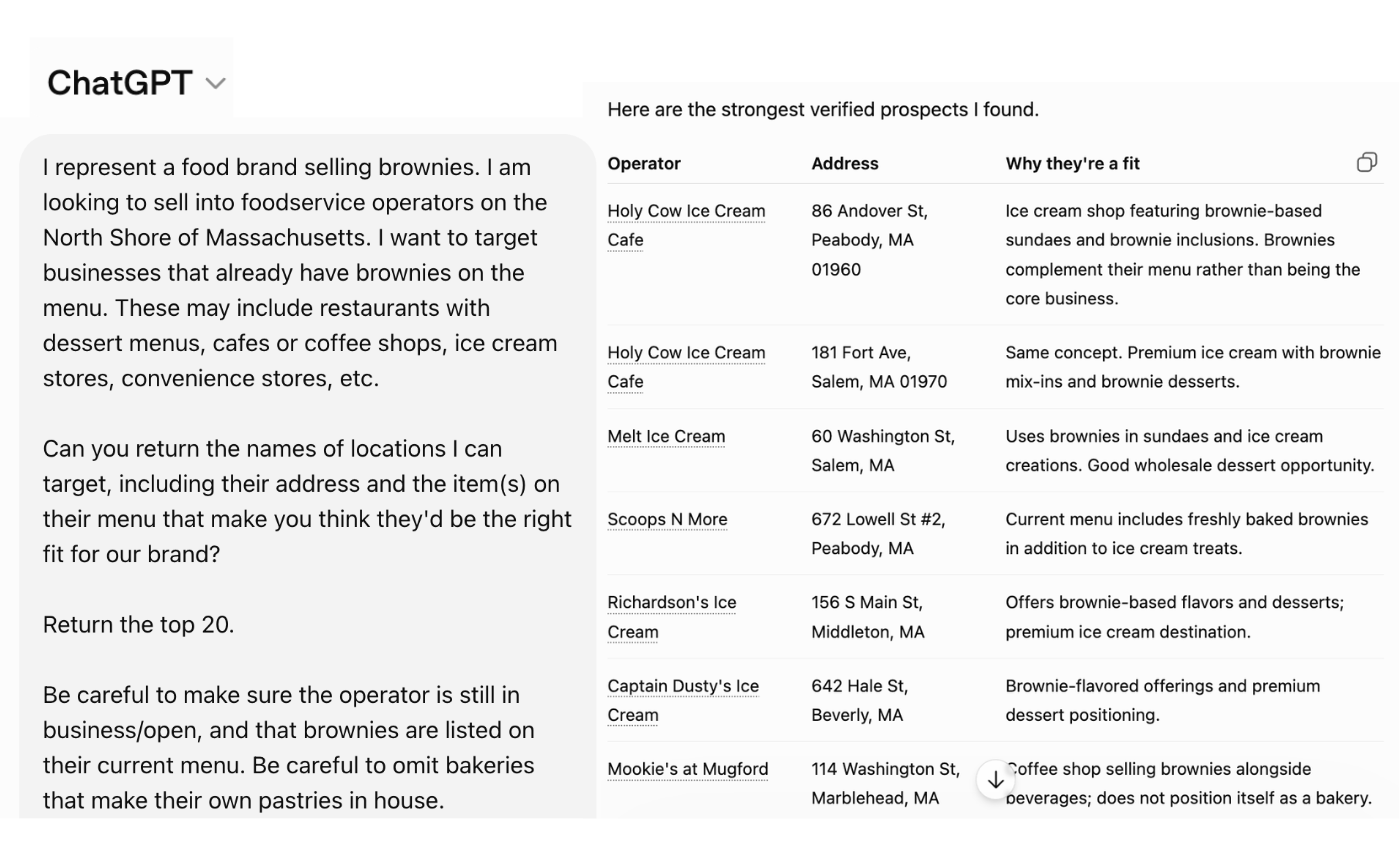
AI search tools like Perplexity, Claude, Gemini, or ChatGPT can take a well-written prompt and return a candidate list with reasoning. Sometimes, they can even uncover restaurant owner emails for the locations you’ve verified are a fit.
But LLMs aren't proprietary restaurant databases, so they miss operators and don't verify emails, leaving your total addressable market unknown.
Pros:
- Free (paid plans for large research needs)
- Fast
- Lets you specify inclusion/exclusion criteria in plain language
Cons:
- Limited information uncovered
- Results need to be fact-checked
- If provided, decision-maker names and email address are often outdated
Option 4: Purchase a pre-built restaurant email list
For teams who want to skip manual research altogether, restaurant email lists are easy to buy. A quick search turns up dozens of data brokers and list marketplaces selling spreadsheets of tens or hundreds of thousands of restaurant contacts for a flat fee — no research required on your end, and the file lands in your inbox within minutes.
But pre-built restaurant email lists have their cons. Emails are often generic and not representative of restaurant owner email addresses, franchise locations are frequently misattributed, and bounce rates can be high enough to damage your sender domain reputation.
Pros:
- Fast to acquire
- High-volume lists
- Some lists are sold by segment, channel, or size
Cons:
- Restaurant email lists are compiled once and resold many times
- A meaningful share of contacts have already moved on, closed, or changed roles by the time you buy
- No way to confirm menu fit, so you end up purchasing a lot of information you can’t use
- Often has misattributed franchise locations
- Filtering the lists requires additional skills
- Bounce rates of 20-30%+ are common on purchased restaurant email lists
- Requires a second step of testing email deliverability to protect your domain reputation
Option 5: Use B2B data platforms for restaurant owner contacts
Instead of manually stitching together online searches, B2B data platforms for restaurant owner contacts do all that work for you. They are easily filtered, so you can quickly find the operator segments you want to engage and access contacts instead of building a list by hand.
Pros
- Fast
- Eliminates manual research
- Filtering capabilities
- Email addresses included
Cons
- Recurring cost for access
- Not all B2B data platforms are equal
Evaluating restaurant industry executive contact databases
Not all restaurant industry database providers are built the same way. When you're evaluating one, it's worth checking:
- How the data is sourced. If the platform only sources Google Maps and LinkedIn, it will save you time but won’t deliver your TAM. Ask questions about the depth of contact research and if manual QA is added on top of other sources. Have clarity on where the data and restaurant owner email addresses are coming from.
- How often the data is refreshed. Static platforms go stale fast in foodservice (an industry known for its turnover.) Look for platforms that combine licensed data with active research and re-verify contacts on a regular basis. Better yet, look for platforms that do contact verification on-demand. Don’t be afraid to ask about bounce rates.
- Whether it targets the right titles. A restaurant email list full of general managers isn't much better than one full of generic info@ addresses if your product decision actually sits with a culinary director or purchasing manager. Role-specific targeting matters more than raw contact count. Also check chain logic and ask how they manage franchise decision makers.
- Coverage of independents and small chains. Big chains are easy to find contacts for; mom-and-pop restaurants and the "Goldilocks" operators in the middle — four to 50 units, with shorter sales cycles — are exactly the segments that are hardest to reach through free methods. If you’re paying for a tool, ensure these type of contacts are included.
- Filtering depth. The ability to segment—by cuisine, menu item, chain size, traffic, location, etc.—turns a generic restaurant email list into a targeted one, which is the difference between a 2% response rate or 15%.
- Built in outreach. Some B2B data platforms will require you to export lists, verify contacts, and then upload them to secondary tools before you can do any sales outreach. This often means an additional cost. Confirm capabilities and determine what workflows your team needs to be successful and efficient.
How First Bite Compares to Apollo and ZoomInfo
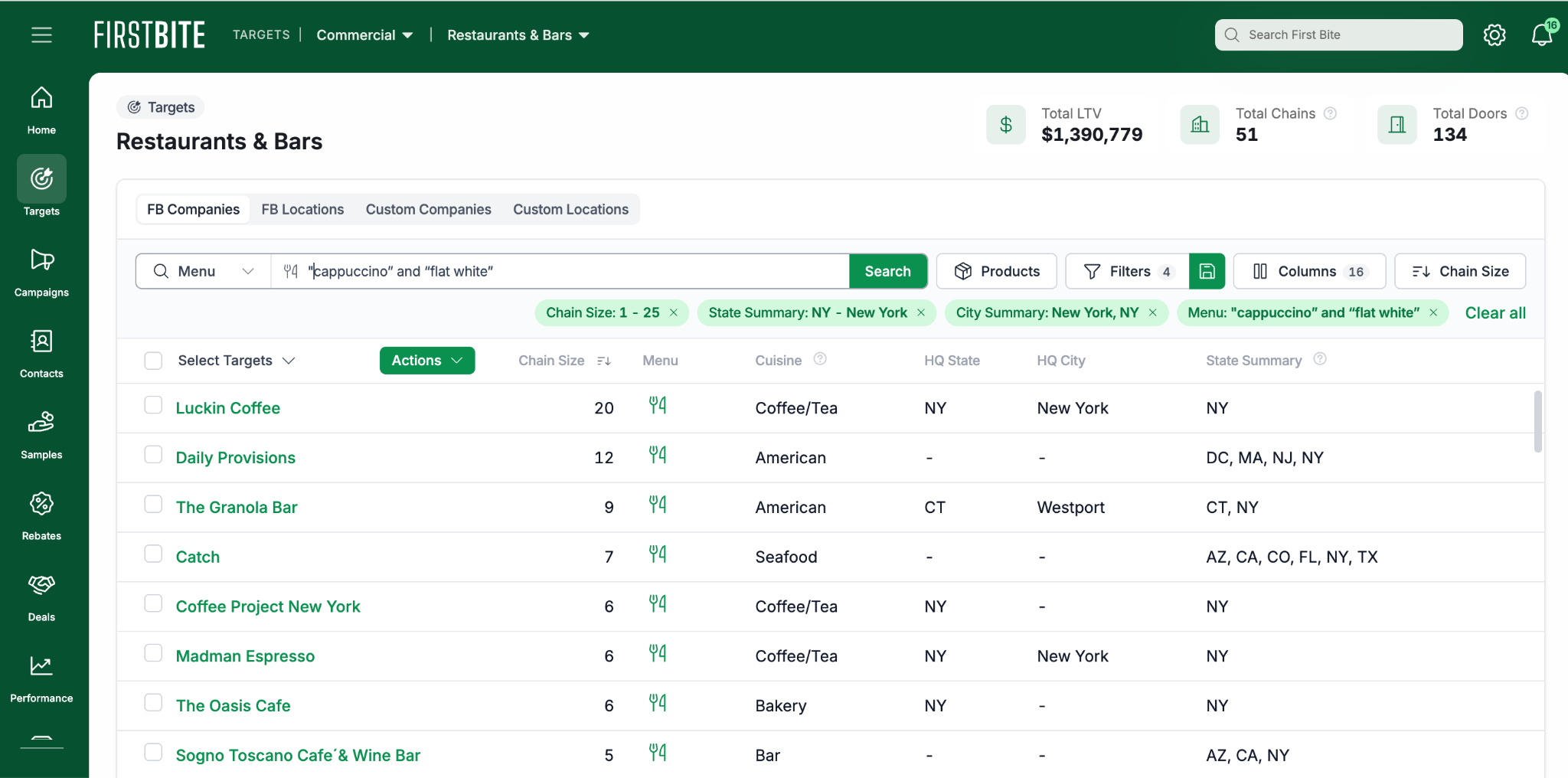
Filtering: First Bite includes menu data that enables you to quickly sort restaurants by cuisine type, specific menu items, chain size, traffic level, expense category, and a lot more. While general B2B databases have filtering for metrics like revenue and location, they don’t dig into what foodservice manufacturers really need to identify their TAM.
Coverage: Since First Bite is built specifically for foodservice, it includes more operator contacts—including independent restaurants, which make up roughly 69% of U.S. restaurant locations—along with other commercial and non-commercial operators.
General B2B databases like Apollo and ZoomInfo have broad cross-industry coverage but are not designed to comprehensively map foodservice buying organizations or the decision-makers within them. They have strong information on Top 500 chains, but not the full market.
Sourcing: First Bite researches against 30+ sources and does manual inquiries to surface current foodservice contacts with purchasing authority. ZoomInfo and Apollo find contacts by crawling public websites and LinkedIn profiles, buying data from partners, and relying on crowdsourced contributions from users who share their contact books or email signatures in exchange for platform access.
The ZoomInfo and Apollo model works well for large corporate accounts with active web and LinkedIn presences, but independent restaurants and small operators often don't maintain the digital footprint these crawlers depend on, so records go stale between refresh cycles and coverage is thin for foodservice.
Quality: Most sales teams using general B2B databases like Apollo and ZoomInfo must still verify contacts before sending emails because employee turnover and data decay can quickly increase bounce rates. Keeping campaign bounce rates below 2% is recommended, but many teams see higher rates if they send exported lists without additional verification.
First Bite contacts are researched in real time every time a user submits a request, so you're never working from stale data. This helps maintain consistently low bounce rates across outreach campaigns.
Case Study: Using a restaurant owner contact information database
Sweet Loren's Sales Director Kyle Watts was spending 10 hours a week manually scouring Google, directories, and LinkedIn for restaurant and school contacts — a process he called "truly depressing.”
After switching to First Bite, that same prospecting work dropped to five to ten minutes per campaign.
In Sweet Loren's first 90 days, Watts sent 1,547 personalized emails, generated 148 qualified operator samplings, and closed 30 confirmed C&U wins (an estimated $150K in annual revenue) plus 3 confirmed QSR wins across 23 locations (an estimated $115K in annual revenue).
Is it legal to use restaurant email lists?
Yes, you can legally send targeted sales emails to restaurant decision-makers in the United States. Under the CAN-SPAM Act (the federal law governing commercial email), you're allowed to send business-to-business emails to work addresses without getting opt-in permission first. This is fundamentally different from consumer email marketing.
Adhere to these guidelines to remain compliant:
- Use your authenticated company domain – Send emails from your verified domain (name@yourcompany.com) so recipients clearly see your company identity in the "From" field.
- Write honest subject lines – Make sure your subject lines accurately describe what's in the email (product samples, special pricing, product information).
- Provide your physical mailing address – Include your company's valid physical address in your email signature.
- Have an easy opt-out option – Include a one-click unsubscribe link or a reply-based unsubscribe prompt.
- Respect opt-out requests – When people want to unsubscribe, immediately remove recipients from all future campaigns.
The best way to find restaurant owner email addresses for outreach
Free tools are useful for researching individual restaurants, but they weren't designed to build a repeatable foodservice prospecting process. As your target market grows from dozens of accounts to thousands, manually finding operators, identifying decision-makers, and verifying contact information quickly becomes a bottleneck.
Foodservice-specific prospecting platforms like First Bite solve that problem by combining restaurant intelligence, verified contacts, and outreach workflows into one system.
Ready to access verified restaurant owner email addresses for outreach?
Read more
Introducing First Bite’s enhanced email sequencing tools

Finding targets: First Bite filters and menu searches
Hate data entry? First Bite offers a better CRM for food industry sales
Start closing better foodservice deals today
